

🔗 Read the full paper here: https://arxiv.org/pdf/2502.06771
The Challenge: Tracking Particles in a Sea of Noise
In high-energy physics experiments, reconstructing the trajectories of charged particles is a fundamental yet computationally demanding task. When particles collide at near-light speeds inside detectors like those at the Large Hadron Collider (LHC), they leave behind traces—tiny points of ionization in silicon sensors. The challenge? Distinguishing real particle tracks from the overwhelming number of random noise hits that appear in the detector. Traditionally, this is solved using complex tracking algorithms based on supervised learning, which require large labeled datasets and significant computing power.
But what if we could make the system learn by itself, without predefined labels, and do it more efficiently?
A New Approach: Neuromorphic Computing
Instead of using classical machine learning techniques, we explored a completely different paradigm: neuromorphic computing. Inspired by the way biological brains process information, neuromorphic computing uses Spiking Neural Networks (SNNs), which rely on time-encoded impulses—”spikes”—to process data.
Our idea was to encode the position of detector hits as time-delayed spikes in a neural network. The neurons would then learn to recognize meaningful particle trajectories from noise through a biologically inspired learning rule called spike-timing-dependent plasticity (STDP). This method allows the system to self-organize, reinforcing synapses that contribute to useful patterns and weakening those that do not—all without any supervision.
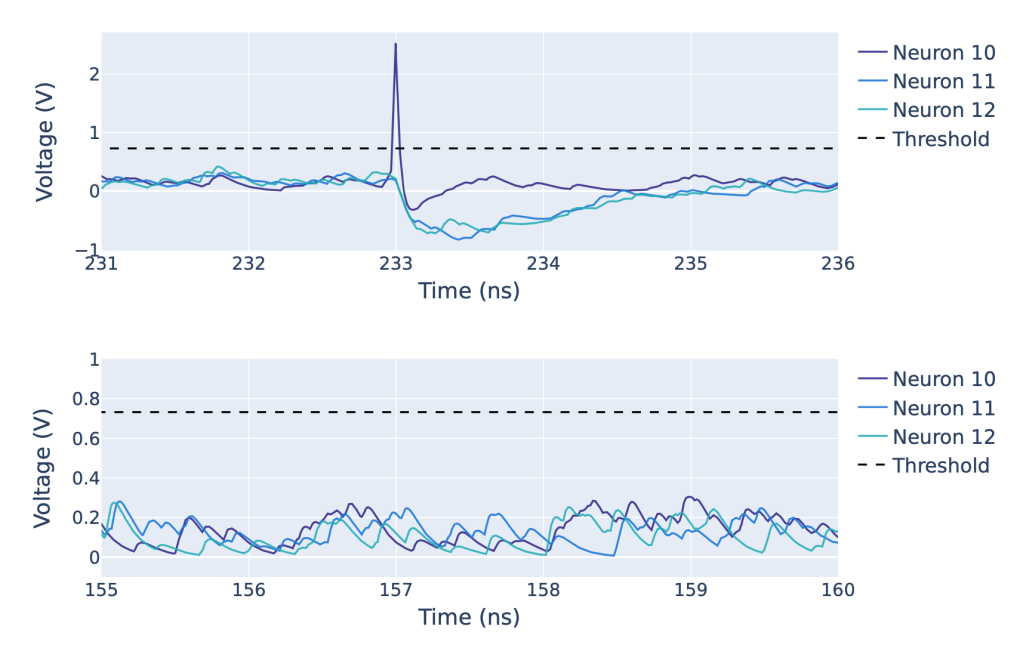
Here a plot of the potential of firing and non firing neurons.
One of the biggest challenges we faced was determining the best configuration of hyperparameters for our Spiking Neural Network. Parameters such as synaptic delays, neuron firing thresholds, and learning rates all needed to be fine-tuned for optimal performance. Given the complexity of the system and the vast number of possible parameter combinations, a brute-force search was impractical.
To address this, we developed a genetic algorithm to evolve the best-performing network configurations. Genetic algorithms mimic the process of natural selection by iteratively refining a population of candidate solutions. We started with a diverse set of randomly initialized SNN configurations, evaluated their performance on particle tracking, and then selected the best ones to produce new configurations through mutation and recombination.
The Results: Unsupervised Learning with Remarkable Accuracy
We tested our approach on a model of the CMS Phase-2 silicon tracker, simulating thousands of particle collisions.
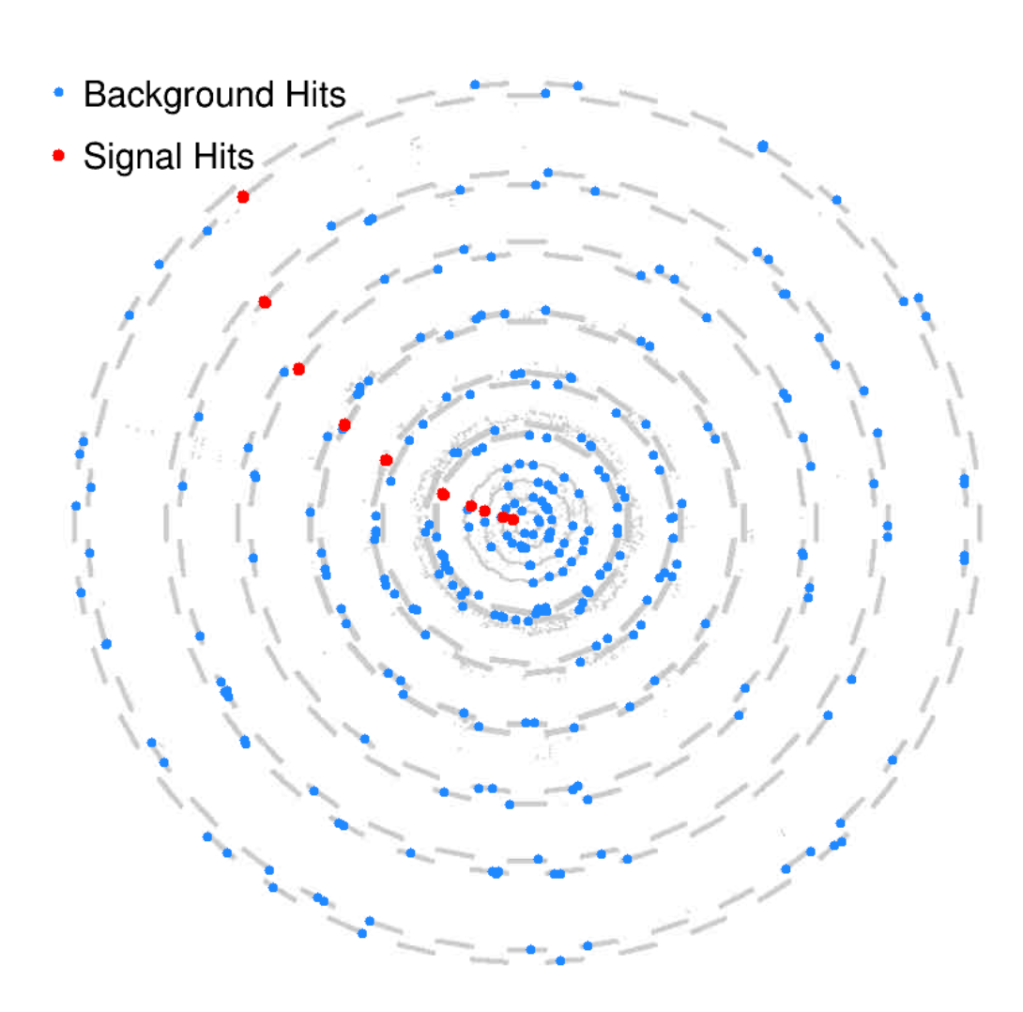
The results were impressive:
- Over 98% track acceptance across all tested particle momentum classes.
- Extremely low false positive rate (~3%), meaning the network effectively filtered out noise.
- High selectivity, with neurons specializing in recognizing distinct particle trajectories.
Even in the presence of substantial background noise, the network adapted and successfully identified true particle tracks. The added advantage? Neuromorphic computing is inherently more energy-efficient than traditional digital approaches, making it a promising candidate for real-time tracking applications in future high-energy physics experiments.
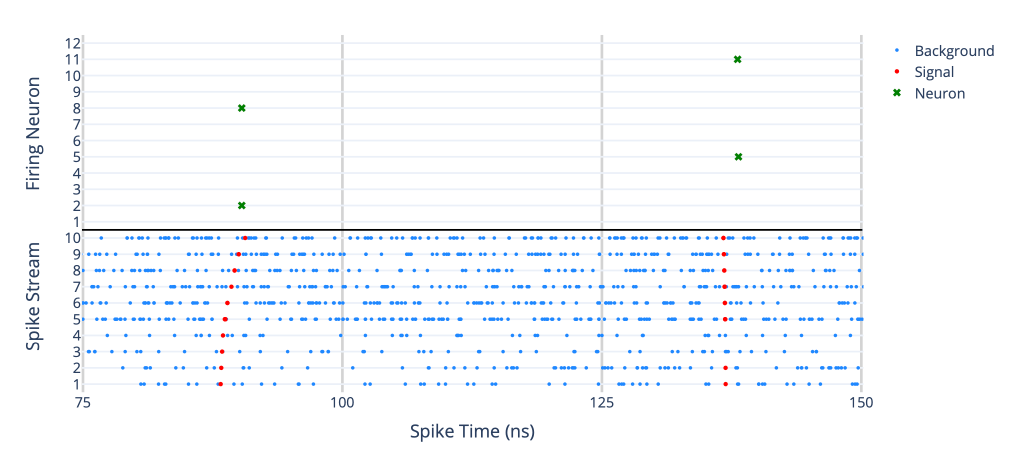
This work is just a first step, but it highlights how this alternative computing paradigm can be applied to long-standing problems in physics.
This work was the result of a fantastic collaboration with Emanuele Coradin, with whom I worked closely to develop the key ideas that were fundamental to the project’s success. Special thanks to Prof. Tommaso Dorigo (University of Padova), Prof. Fredrik Sandin (Luleå University of Technology), and Prof. Mia Tosi (University of Padova) for their invaluable guidance, supervision, and insightful contributions. Their proposed solutions and ideas played a crucial role in shaping this research. I also extend my gratitude to the other members of the collaboration, including Muhammad Awais, Enrico Lupi, Jinu Raj, and Eleonora Porcu, for their dedication and contributions. I’m excited to see where this research leads next!
This work was presented at the 4th MODE Collaboration Workshop, where we shared our findings with the broader scientific community.
 Fabio Cufino