
“My fascination with particle physics began at CERN in 2017, when I had the incredible opportunity to see the CMS experiment up close. Standing in the cavern, I was amazed by the complexity of the project. That moment became the catalyst for my lifelong dedication to particle physics.
I remember vividly deciding to pursue this path and promising myself that I would return one day, but as part of the community.”
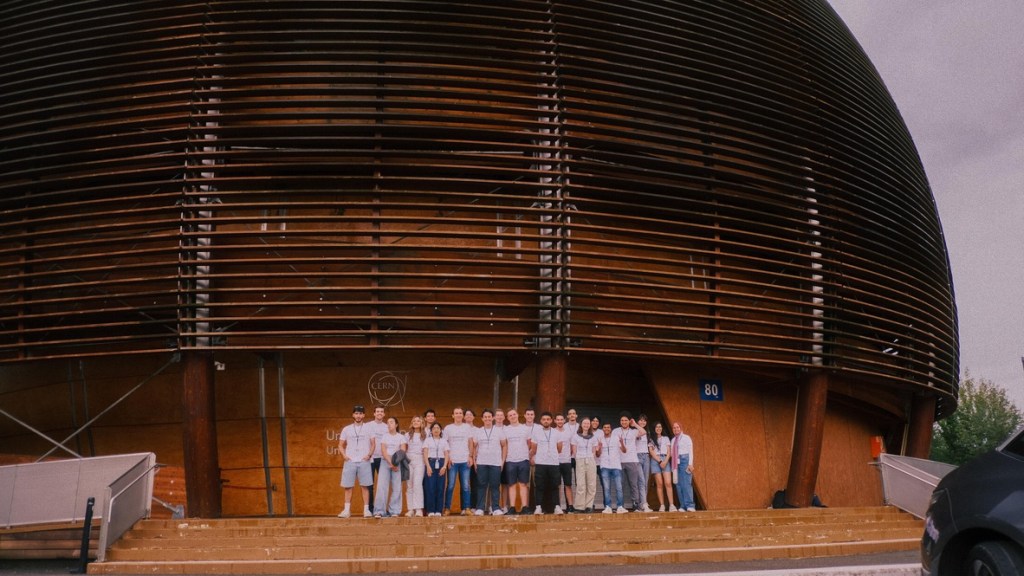
This summer that dream became a reality when I joined CERN as an Openlab Summer Student. Walking into CERN every day, thinking that 100m below my feet billions of particles are colliding every second felt great.
The CERN openlab Summer Student program is structured in a way that allows students to work closely with experienced supervisors while contributing to real-world projects. From the start, each student is assigned a specific project and 2 dedicated supervisors. The aim is to align your work with the ongoing research initiatives at CERN, making the contributions impactful as possible and applicable. I was fortunate to work on a project involving deep learning for muon track reconstruction, with the guidance of two supervisors who helped shape and support my progress throughout the summer.
If you’re considering applying, I highly recommend enhancing your CV with experiences that go beyond academics. This is literally the reason why I got chosen.
The Experience
The environment is highly collaborative, and you’re not just left to work alone. Regular meetings with supervisors and other team members ensure you’re on the right track while giving you a chance to ask questions, learn new techniques, and exchange ideas. This kind of mentorship really enhances the learning experience.
One of the things that truly stood out to me at CERN was the balance between hard work and leisure. CERN’s research fellows know how to make time for fun, and it’s not uncommon to find people at the institute organizing barbecues, laser tag events, and even festivals together.
It’s exactly like the big bang theory.
I joined in on some of these activities, and it amazing! I especially appreciated how much importance was placed on these events as part of creating a healthy working environment. It’s not just about the work at CERN; it’s about stress relief, mental well-being, and perceiving a sense of community. That atmosphere, in my view, is essential to maintaining focus and creativity.
As an openlab summer student you are asked to present you work in presentation:
During my last week, I had the chance to participate in a Hackathon for the scouting group (the group I was in) at Idea Square. This was an amazing experience where I worked closely with my supervisors and the entire group. It was incredible to see everyone come together, share knowledge, and collaborate on small projects based on creative ideas. What makes this type of work so rewarding is that if you have an idea, you’re given the time and resources to develop it, and that’s one of the best aspects of working at CERN.
The Project: Muon Track Reconstruction with Deep Learning
While the experience at CERN was invaluable, the project I worked on was equally rewarding. I had the chance to apply deep learning to one of the most critical tasks in the Compact Muon Solenoid (CMS) experiment: muon track reconstruction. My work was focused on improving the Barrel Muon Track Finder (BMTF), part of the Level-1 Trigger (L1T) system, which filters and processes the immense data generated by the Large Hadron Collider.
Traditionally, the Kalman Filter is used for real-time track reconstruction. However, with the High-Luminosity LHC (HL-LHC) coming online, the current system faces challenges in handling the increased data rates. My project introduced Neural Networks as a solution, leveraging machine learning to make the reconstruction process more efficient and accurate.
Key Takeaways

The summer was truly magnificent, not only because of the exciting project but also due to the incredible people I met along the way. Connecting with fellow interns and researchers who shared my passion for physics and AI fostered an enriching environment. We formed bonds over our shared objectives, engaging in lively discussions and brainstorming sessions that extended beyond our work.
Huge thanks to Jonas, Bram, Naim, Tatis, and JC for being such an important part of this adventure.
P.S. Search for FaunoFobici in the tunnels.
 Fabio Cufino